

Is your German Investing App like Scalable Capital or Trade Republic Safe? Like most of us you might have built up a solid portfolio in Germany. Feeling good with a diversified and long-term focus.
But then you hear something unsettling:
“What if my German Investing Broker goes bankrupt?”
Does that mean your hard-earned investments vanish overnight? Is your money safe? What about the €100,000 deposit protection?
In guide , Ill am going to break it all down. You’ll learn:
- What really happens when a broker goes bust
- Whether ETFs are protected like bank deposits
- And how you can reduce your risk without panicking
The €100,000 deposit protection in Germany
Let’s start with The €100,000 question, literally.
Many people ask:
“Is my portfolio protected under the deposit guarantee scheme up to €100,000?”
And the answer is… no.
That protection only applies to cash deposits at a bank: Your checking account (Girokonto), Savings accounts (Tagesgeld, Festgeld), Maybe even your money market account
If the bank collapses, the German government (or relevant EU authority) will guarantee up to €100,000 per bank, per person. Sounds good, right? But here’s the catch:
In a massive financial crisis, that promise might get stress-tested.
That’s why many experts, myself included, suggest not holding more than €100,000 in total bank cash deposits, even spread across different banks. Just in case.
Related Guide: Financial Planning for Expats in Germany
Are Stocks and ETFs in German Investing Apps safe?
ETFs and shares in German Investing Apps are Safe. They are not bank deposits. They’re not even part of the bank or broker’s balance sheet.
Securities like stocks and ETFs are classified as “Sondervermögen”, or special segregated assets.
“Special fund” is a legal term regulated in the Capital Investment Code (§§ 91 ff. KAGB), formerly the Investment Act. Simply put, it refers to the money that you, as an investor, have invested in stocks , funds , or ETFs, for example , with an investment company, legally known as a capital management company. The special fund is thus separate from the assets belonging to the capital management company itself.
That means:
- Your stocks and ETFs do not belong to your broker
- They are held in custody separately, usually by a third-party clearing institution
- Even if your broker or the ETF issuer goes bankrupt, your shares remain untouched
What does Safe Mean Here?
Here’s a simple analogy:
Imagine your broker is a storage facility.
You rent space there, and you store your belongings in this case stocks and ETFs. If the storage company goes out of business, you don’t lose your stuff. You simply pick it up, or it’s transferred elsewhere. The company was just holding it.
This setup applies even if the fund provider (like iShares or Vanguard) goes bankrupt. They’re just managing the fund. You still own the underlying assets —like Apple stock, or government bonds in your name.
So: If a broker or fund company goes bankrupt, your ETFs are still yours.
What Happens If a German Investing Broker Goes Bankrupt?
Let’s say your German Investing broker (BAFIN approved) goes bankrupt. What happens next?
The first thing would be Temporary Access Issues:
You might temporarily lose access to your account. That’s stressful, but not catastrophic.
Then there will be an Asset Transfer:
Your Securities like Stocks and ETFs will be migrated to a new custodian or broker. In some cases, you may even be able to choose the destination.
In the Great financial crisi of 2008, Investors of Security holdings didnt lose their assets when large banks collapsed. Their securities were eventually transferred to other brokers. However and this is important, If you have invested money in so-called derivatives, you risk total loss if the issuer of the derivative becomes insolvent. Derivatives are complex financial products that do not invest directly in stocks, bonds, etc., but are merely derivatives of them.
As derivatives are not special segregated assest, they are just promises from a bank or the issuer. So only invest in Complex products like derivatives, warrants, puts or calls if you know exactly what you are doing.
Related Guide: Scalable Capital VS Trade Republic
Is Cash in German Investing Apps Safe?
While your Stocks and ETFs are protected, cash sitting in your brokerage account is not necessarily safe above €100,000.
For example:
- Uninvested funds waiting to be used
- Dividend payments that haven’t been reinvested
- Interest from bond ETFs
That cash is just like money in a bank account.
It may fall under the deposit guarantee scheme but only up to €100,000, and only if your broker uses a licensed bank partner.
So it’s smart to keep excess cash elsewhere or reinvest it promptly.
Why Cash Might Not be Safe in your German Investing App
There might be some cases where your cash is not Safe in you German Investing app. Here you must the parent and holding institutions.
Many neo brokers and neo banks are simply an interfacing mediums. Meaning that they offer services backed by another financial institution. Superficially you might be using 2 different banks thinking that you have up to 200 thousand euros insured. But at the back end both the service providers might be using the same bank and under the law only €100k per person per credit institution in is covered.
We just talked about splitting cash amounts with multiple banks but should you also spread your Stocks and ETFs across Multiple brokers in case one of them fails?
You can distribute your investments with different investment apps and I actually use multiple brokers my self and encourage people to do so but not because of deposit protections because that doesn’t apply to stocks and ETFs anyway.
The main benefit of using multiple brokers is reducing operational risk.
For example: If Broker A goes down temporarily, you can still access Broker B, If one platform has technical issues or a cyberattack, you’re not fully locked out and You can take advantage of lower fees or different product ranges using various brokers.
This isnt strictly necessary but for peace of mind, it is definitly an option you should look into.
Related Guide: Best Online Brokers & Investing Apps in Germany
Are all ETFs in Germany equally safe?
The answer is No, not all ETFs are covered and safe. Be careful with synthetic or leveraged ETFs. These use derivatives or financial engineering and carry counterparty risk. Sticking to physically replicating, globally diversified ETFs should be looked into if your goal is safety and simplicity.
This means that investing through a neobroker riskier than using a traditional bank?
Not inherently. Neobrokers are also regulated and use custodial banks to hold your assets. The legal protection of stocks and ETFs as Sondervermögen applies regardless of platform.
Are German Apps Like Scalable Capital or Trade Republic Safe and Trustworthy?
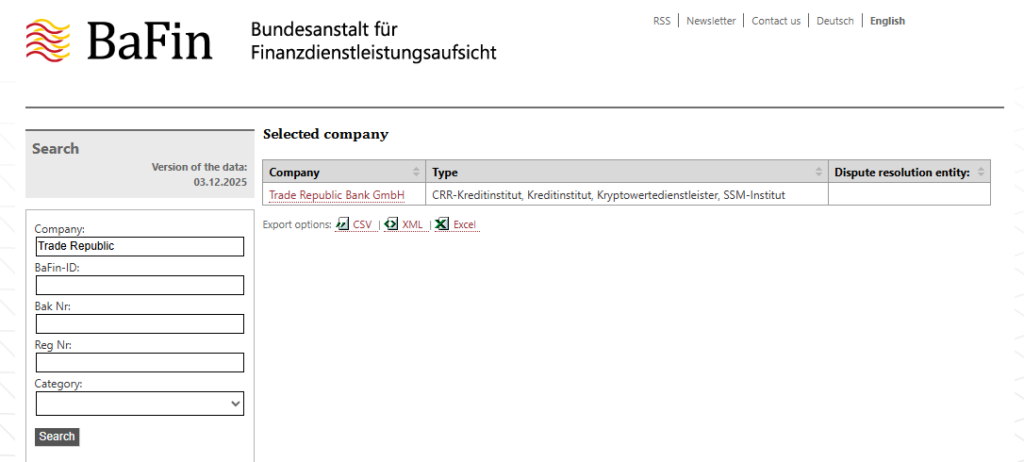
You can easily check if an app like Scalable Capital or Trade Republic is trustworthy. Look for: BaFin regulation by Simply going to this website:
Add the name of the company and check what they are allowed to do and what not. Also make sure that there is Clear ownership and custody structure.
For newer companies it might be difficult to see and Established track record but if they have a backing by licensed institutions it can be a good sign of trustworthyness.
How to Reduce Risk from German Investing Apps?
Even if your German Investing app or broker is safe, its no guarantee that your Money is safe. Because stocks and ETFs can drop in value if the markets do.
Broker safety protects custody, not market performance. That’s why long-term investing and diversification are crucial.
So at the end of the day, if your german investing app is approved and regulated by BAFIN , then its quite safe but there is always some risk.
Disclaimer: None of the content in this article is meant to be considered as legal, tax or investment advice, as I am not a financial expert or a lawyer and am only sharing my experience with stock investing. The information is based on my own research and is only accurate at the time of posting this article but may not be accurate at the time you are reading it.